
Find People Through Forsyth Records
Start with the strongest fact already known. A street address points to the Forsyth County Board of Assessors, where qPublic connects a parcel with an assessed owner, mailing address, legal description, sales, and map links. An owner name can then move into the deed index as either grantee, the person receiving property, or grantor, the person conveying it. A case number is stronger than a name for court work. Family dates belong in probate, vital, newspaper, and cemetery sources. Each trail answers a different question, so no single result proves where someone now lives.
A phone number has no verified countywide reverse directory in the research. Use it only to confirm a public office or business contact through an official directory. For an old address, record the parcel ID and legal description before following deeds backward or forward. Postal city names can mislead: many addresses labeled Cumming lie outside the incorporated city and belong with county custodians.
- Search qPublic by owner, parcel, or location, then save the parcel ID and legal description.
- Check the deed index for matching grantor and grantee names, dates, and book or page references.
- Use the right court and compare case number, role, date, and disposition before accepting a match.
- For family history, combine probate files with newspapers, cemetery sources, and archival vital indexes.
- Ask the actual custodian for a named file or date range when the online trail ends.
| Source type | What it can establish | Main limit |
|---|---|---|
| Official county or state index | A current citation from the originating system | May omit images or protected fields |
| Certified custodian copy | An authenticated version of the filed record | May require a fee and eligibility |
| Commercial compilation | A lead assembled from several sources | Can merge names, lag corrections, and hide provenance |
Use a compilation only to form a lead. Confirm each important point with the office that created or keeps the record.
Forsyth County People Records Offices
The Clerk of Superior Court serves as both land recorder and custodian for Superior and State Court files. The Board of Assessors maintains the ownership roll, while Probate Court keeps estates, county marriage records, and local birth and death certificate services. Cumming handles its own municipal records, but most land in Forsyth County is unincorporated. The distinction matters when a mailing address says Cumming. Full access rules, copy choices, and request steps appear with Forsyth County public records.
Clerk Real Estate Division
101 E. Courthouse Square, Suite 1007
Cumming, GA 30040
770-781-2120, option 6
Forsyth County Probate Court
100 W. Courthouse Square, Suite 008
Cumming, GA 30040
770-781-2140
Search Forsyth Owners Before Deeds
The Forsyth County qPublic search accepts an owner name, parcel number, or location address. Its parcel card can show the assessed owner, mailing and site addresses, parcel identifier, legal description, values, sales, and improvements. A parcel is a mapped tract used for tax and land records. The mailing address may be the best lead to an owner, but it is only where tax mail goes. The site, or situs, address identifies the land. Neither proves who occupies it today.
| Search choice | Best starting fact | Useful result |
|---|---|---|
| Owner Name | Surname or owner entity | Parcel and mailing link |
| Parcel Number | Known tax or map ID | Exact parcel card |
| Location Address | Street number and name | Site and assessed owner |
The county GIS viewer adds parcel geometry and district context, but its boundaries are representations, not a certified survey. The county's GIS gateway shows where to reach those tools.
Open the Forsyth GIS and parcel tools before reviewing the captured county gateway.
The gateway is useful for mapping a parcel, while the deed index remains the source for recorded transfers.
Note: A blank owner result can reflect lawful suppression for a qualifying safety-sensitive worker rather than a lack of ownership.
Turn Forsyth Parcels Into Deeds
Once a parcel yields an owner and legal description, move to the Clerk's land index. The county Cott eSearch guest form uses last or firm name, middle and first names, title, party, same-instrument, and date controls. GSCCCA supplies a statewide route with county, name, instrument type, date, book and page, and file-number fields. Try a person as grantee to locate an acquisition and as grantor to locate a later transfer. Exact coverage varies by series.
- Index
- A finding list that points to a recorded instrument; it is not the full document.
- Grantor
- The party conveying an interest in property.
- Grantee
- The party receiving that interest.
- Book and page
- A citation used to retrieve the recorded image or certified copy.
General land indexing begins in 1980, while plat, lien, partnership, and trade-name series begin on different dates. Earlier deeds require the Clerk counter, archived books or microfilm, or archival research. For official statewide access, open the GSCCCA real-estate search.
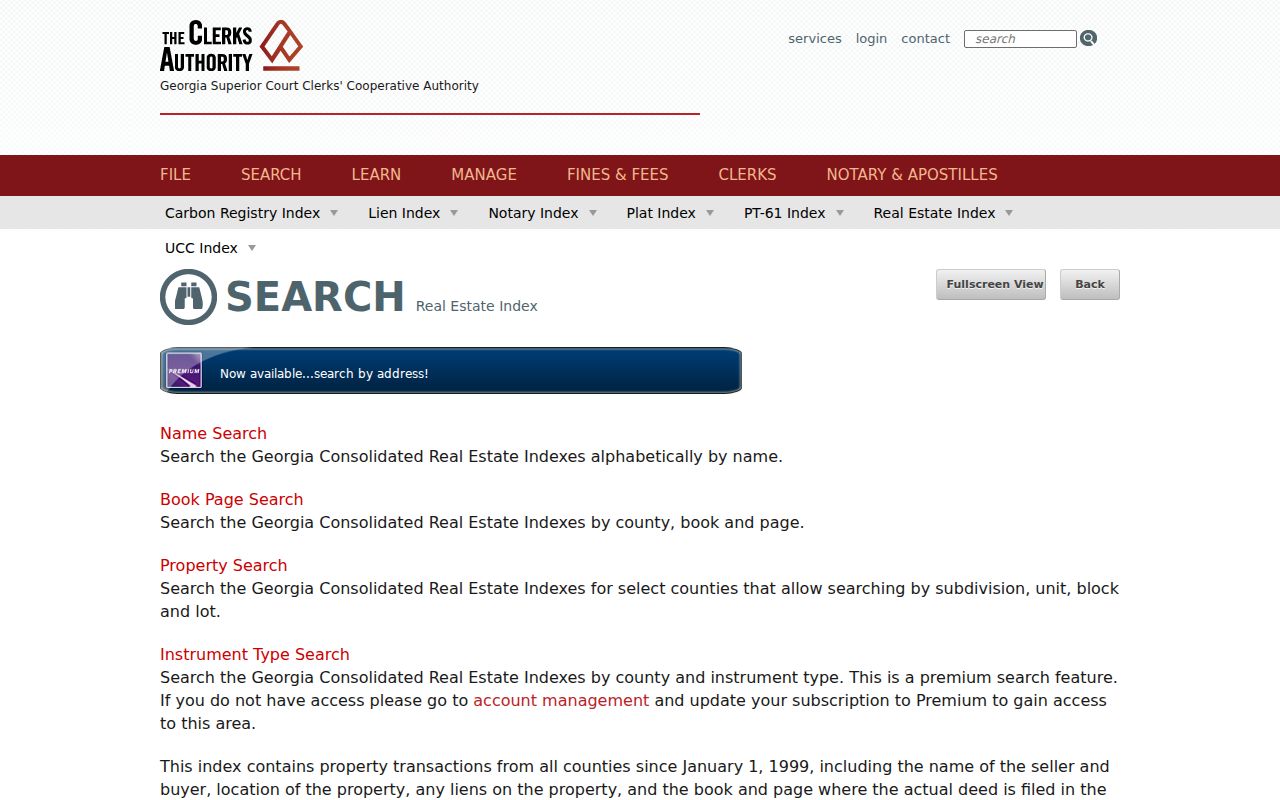
The screen provides the index route; certification and full-file questions still go to the Forsyth County Clerk.
Check Forsyth County Court Records
Forsyth County has Superior, State, Magistrate, Probate, and Juvenile courts, plus Cumming Municipal Court. Georgia re:SearchGA can expose a party or case-number index where the court and user role allow it. A docket is the dated list of activity in a case. Results may include the court, case number, parties and roles, case type, filing status, docket events, attorneys, and disposition. The Clerk keeps the actual Superior and State files.
Juvenile, adoption, sealed, and other restricted matters are not open name sources. When the portal has no usable image, request an exact docket item from the right clerk. The criminal copy form accepts defendant, case number, year, charge, date of birth, and a requested accusation, indictment, or final disposition. Certified and restricted copies cannot be emailed.
| Court | Covers | Name Search | Access |
|---|---|---|---|
| Superior and State | General civil and criminal matters | re:SearchGA or case number | Portal, Clerk file, copy request |
| Magistrate | Small civil claims and warrants | Local court resources | Court counter or request |
| Probate | Estates and marriage matters | Partial electronic access | Probate counter or copies |
| Cumming Municipal | City ordinance and traffic cases | No general party docket verified | Municipal clerk fallback |
| Northern District of Georgia | Federal cases | PACER | Account-based index and documents |
Read a Forsyth Court Match
Names alone are weak. Compare the case number, court, filing date, party role, attorney, and final disposition. A charge or booking entry is not a conviction. Likewise, a docket citation is not the whole file. If the needed fact is the outcome, ask for the final order or disposition instead of every page. That keeps the request focused and lowers copy cost.
Review the Forsyth County Clerk gateway to identify the correct division before examining the captured office page.
The local gateway matters because portal access, clerk copies, and court-specific restrictions are separate channels.
Use Forsyth County Vital Records
Forsyth County Probate Court accepts written or in-person requests for local birth, death, and marriage records. Georgia DPH holds statewide birth and death records from January 1919 and marriage records from 1952 through 1996. A divorce decree belongs with the Superior Court clerk where the divorce was granted. Current birth and death certified copies require an eligible requester, identification, and proof of relationship where applicable. They are not open person-search indexes.
Family-history research follows different thresholds. Georgia law transfers birth records to the Archives after 100 years and death, marriage-application, and divorce records after 75 years. Before then, the statutory restrictions remain. Older marriage abstractions, probate series, newspapers, and archives can locate a citation without treating a current certificate as public. Georgia's 2025 Andee's Law creates a limited route for an adult Georgia-born adoptee to request an uncertified original pre-adoption birth certificate; it does not open adoption files generally.
Trace Forsyth Heirs Through Probate
Probate petitions are the official trail when the goal is to identify heirs or interested parties in an estate. Give Probate Court the decedent's name, approximate death or file year, and the exact petition, order, or inventory needed. An estate inventory is a snapshot of assets at death. It is normally due within six months of appointment and can be filed in person, electronically, or by mail. Guardianship and adoption material may be confidential even when an estate file is public.
Lawful use. Use Forsyth County records for legitimate personal research. Georgia stalking and harassing-communications laws still apply to facts found in open sources.
Probate can connect a deceased owner to later land transfers, but it should be used only when death or heirship fits the facts. An obituary or cemetery entry can supply a date, while the court file supplies the legal estate relationship.
Follow Forsyth Custody Records Carefully
County jail, state corrections, federal custody, and the Georgia offender registry are separate systems. Search Forsyth Sheriff's sources for current county custody, the Georgia Department of Corrections for state prison or supervision information, and federal sources for federal prisoners. Confirm age, identifier, custody location, and court outcome. A release from one system does not resolve the underlying case.
The Georgia offender query supports name, description, GDC ID, and case-number searches. GDC recommends trying active and inactive records and surname variants.
The state screen identifies its own custody system only. Do not confuse the City of Forsyth, where GDC lists an information mailing address, with Forsyth County.
Work from the narrowest system outward. A county booking can supply a booking number and current status, while a later court file can supply the disposition. State and federal results use their own identifiers and date ranges. Record the source and check date because custody changes. If the goal is notice of a release or transfer, use an official victim-notification channel instead of repeatedly checking or copying roster entries. A most-wanted list also has a limited purpose and should never be treated as a full warrant index.
Use Forsyth Registry Results Safely
The Georgia Bureau of Investigation registry can provide public identifying and status data, but it carries strict warnings against misuse. Use official photos, identifiers, offense information, and current status to distinguish same-name results. Registry information changes and should be checked at the source.
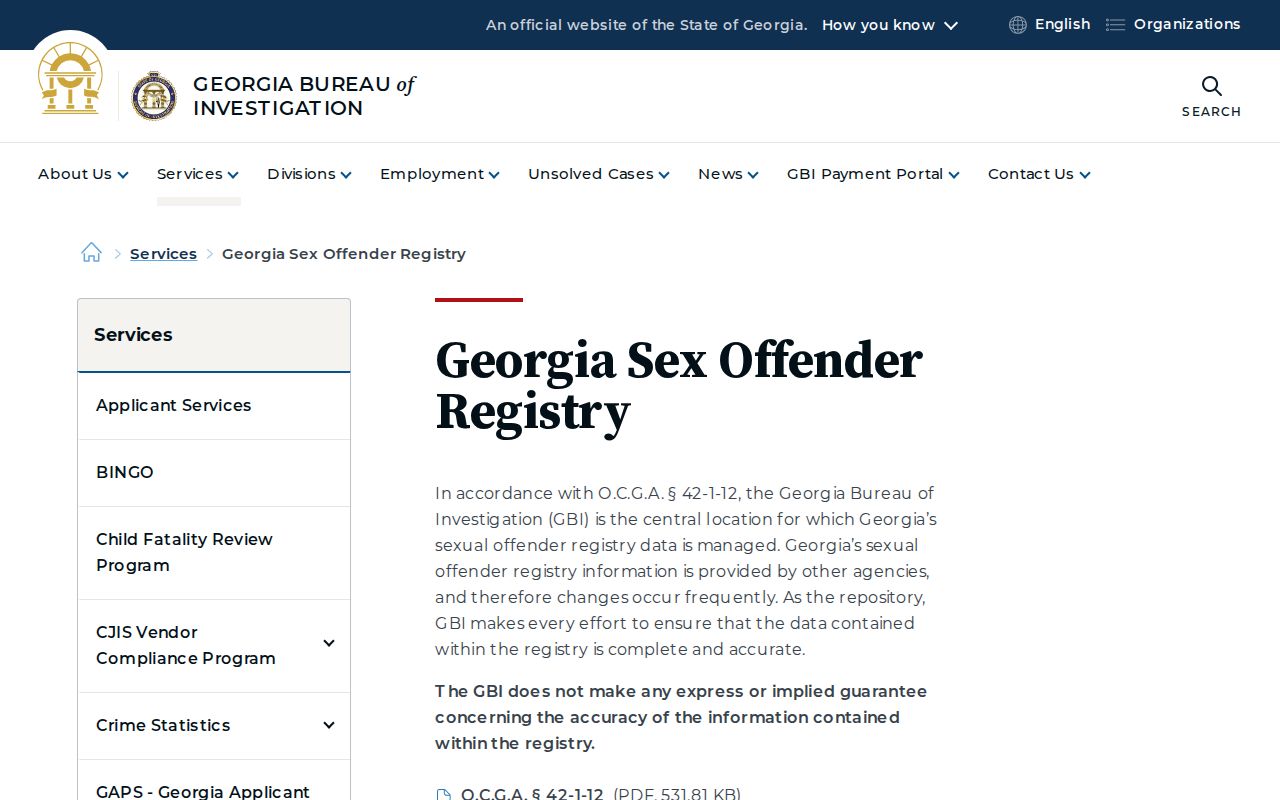
The official page is a verification route, not permission to contact, threaten, or harass anyone listed.
Search Forsyth Business Records
Georgia's business and professional systems can separate people with similar names. The Corporations Division searches business name, control number, registered agent, officer, and designated agent fields. Results may connect a legal entity with its formation, status, office, agent, and filing history. Professional verification uses profession or board, license type, name, and license number. A license result can confirm status and public discipline where available.
Trade names are different. Georgia trade names are county filings, not corporations, and Forsyth County's Clerk is the custodian. A registered-agent address is a legal service address, not proof of residence. Use license or control numbers as the stronger match when names collide.
Business filings work best as a bridge. Begin with the entity record, note its control number and exact legal name, then inspect the filing history for the role and date tied to the person. Compare that result with a county trade-name record, permit, or professional license only when the activity calls for it. An officer listed in one annual registration may not hold the same role now. Preserve the filing date, and do not turn a public business contact into an assumed home address.
Search Forsyth Unclaimed Records
Georgia's unclaimed-property program offers another official trail when money or property has been turned over to the state under a person's or business's name. It can help reconnect an owner or heir with a claim, but a name match still needs the program's claim process and proof. Avoid paid recovery pitches until the free official route has been checked.
Visit Georgia's official unclaimed-property program before viewing the captured state page.
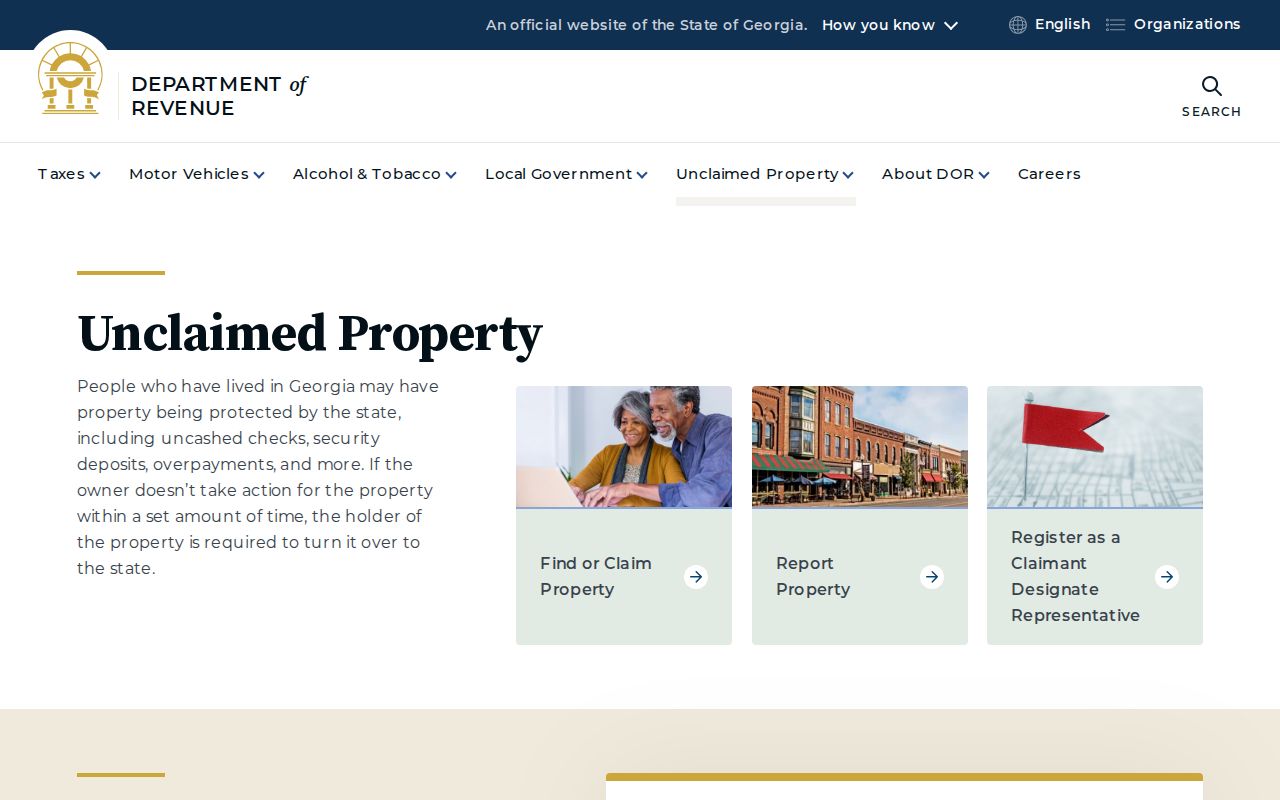
The Department of Revenue route is the source for claim instructions and verification, not a commercial recovery letter.
Search Forsyth History Past Portals
Forsyth County began in 1832, and early work must account for Cherokee land cessions, land-lottery records, and predecessor jurisdictions. Marriages and wills reach 1833 in surviving or abstracted sources, while administrator bonds begin in 1835. The 1905 courthouse burned in an arson fire in 1973, yet the fire did not erase every early series. Microfilmed and surviving marriage and probate records still reach the 1830s.
Forsyth County Public Library grew from a roughly 600-volume WPA library in 1938. Today its genealogy and local-history directory points to FamilySearch, Georgia Archives, newspapers, military sources, and the Historical Society. The library site does not publish exact years for every printed city or reverse directory, so ask reference staff rather than guessing.
Newspapers fill gaps between deeds and census years. Search initials, married and maiden surnames, spelling variants, schools, churches, and legal notices. Treat a printed mention as a lead, then confirm the date or relationship in the originating record.
Lake Lanier adds a special land trail. Former roads, farms, cemeteries, and communities may not appear in a modern parcel search. Pre-reservoir deeds, plats, topographic maps, condemnation files, and newspaper notices can work better. For Black families whose Forsyth trail ends near 1912, the documented expulsion requires careful historical context rather than an assumption of ordinary migration.