
Match Forsyth County Voter Registration
Georgia's My Voter Page, often called MVP, is the official starting point for an individual Forsyth County voter registration search. It is an identity-verification tool, not a public directory that lets someone browse every name in the county. The form combines a name, county, birth date, and security check to find one matching voter. Select Forsyth from the county list. Since the date of birth is used to verify identity rather than displayed as a public result, the form can narrow common-name matches without opening a countywide voter roll.
| MVP field | Control | Required | How it is used |
|---|---|---|---|
| First initial | Text or dropdown | Yes | Part of the identity match |
| Last name | Text | Yes | Exact or normalized name match |
| County | Dropdown | Yes | Select Forsyth |
| Date of birth | Date | Yes | Identity check, not a public result field |
| Security check | CAPTCHA | Yes | Discourages automated access |
The current My Voter Page form is visible here before entering personal details.
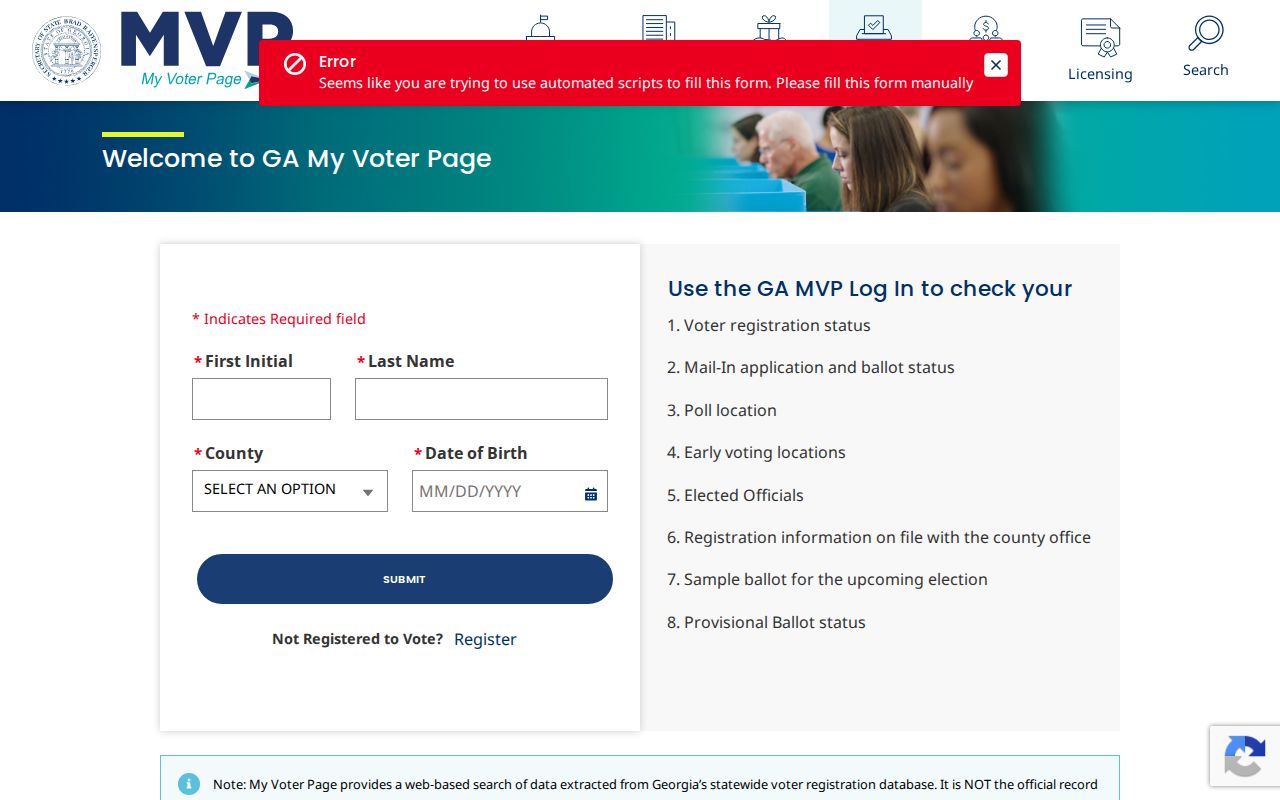
The screen shows why MVP works best for self-service confirmation, not bulk research. If a valid entry produces no match, check spelling and county selection first, then contact the county office. A missing match does not prove the person was never registered.
Forsyth Voter Lookup Results
A successful Forsyth County lookup may show current status, the registered address as presented to that voter, precinct and polling place, political districts, sample ballots, absentee status, and participation history. These parts serve different needs. The polling place and sample ballot are election-specific, while the district assignments explain which contests apply to the voter. Absentee information can help the voter track the administrative status of a request or ballot.
Participation history means only that the voter cast a ballot in a listed election. It never reports which candidate or question the person chose. Georgia uses a secret ballot, and MVP does not alter that rule. The result also should not be treated as proof of present residence beyond what the registration system reports.
| Status | Active, inactive, or another registration state |
|---|---|
| Address | Registered residence shown to the matched voter, subject to protection rules |
| Election geography | Precinct, polling place, and applicable districts |
| Election tools | Sample ballots and absentee-status information when available |
| Participation | Election participation only, never ballot selections |
Note: Georgia does not register voters by political party, so no permanent party-affiliation field should be inferred from a lookup.
Forsyth Voter Records Correction Desk
The Forsyth County Voter Registrations & Elections office is the local contact when a name, address, precinct, or status needs review. Staff also publish registration resources, precinct and polling information, election results and statistics, and board information. The office is at 1201 Sawnee Drive, Cumming, GA 30040. It can be reached at 770-781-2118, by fax at 770-886-2825, or at voter@forsythco.com, Monday through Friday from 8:00 a.m. to 4:30 p.m.
The county elections-services screen provides the official local entry point.
Use this county route after an MVP problem instead of assuming an online result is final. Bring or provide enough detail for staff to locate the registration, but do not send sensitive identifiers through an unsecured channel unless the office instructs you to do so.
Fields in Georgia Voter Records
The official Georgia voter-file layout goes far beyond the short MVP display. It includes the county and voter registration number; status and status reason; name components; birth year; residence and mailing fields; registration and update dates; and codes for the precinct, municipality, congressional district, state legislative districts, courts, county commission, school board, and other configured local districts. Race and gender fields also appear in the state layout. These are administrative voter records, not a profile of every fact about a person.
| Name | Last, first, middle, and suffix fields |
|---|---|
| Residence | Street components, unit, city, ZIP, and district assignments, except protected addresses |
| Registration | Number, date, status, status reason, last modification, and last contact |
| Voting history | Last vote date and participation data, never candidate choices |
| Birth information | Birth year may appear; full date is withheld |
| Last Party Voted | Last selected partisan-primary ballot, not permanent affiliation |
Confidential under Georgia law. O.C.G.A. §§ 21-2-225 and 21-2-234 withhold Social Security numbers, driver's-license or state-ID numbers, full dates of birth, and protected-address information from public voter files.
Forsyth Voter Status Changes
Active, inactive, and cancelled do not mean the same thing. Georgia and federal National Voter Registration Act processes govern list maintenance. A registration may move to inactive status and later to cancelled status only through those procedures. An inactive Forsyth County voter remains eligible to vote, request an absentee ballot, and sign a petition. Inactivity is not cancellation.
A September 17, 2025 county guide reported 181,344 active and inactive registered voters across Forsyth County, including 4,979 in Cumming. An October 12, 2024 snapshot reported 183,615. The dates matter because voter rolls change with registrations, moves, deaths, corrections, and maintenance steps. Never blend snapshots from different dates or present one as a live count.
The county's precinct-card update illustrates how voters receive current precinct information.
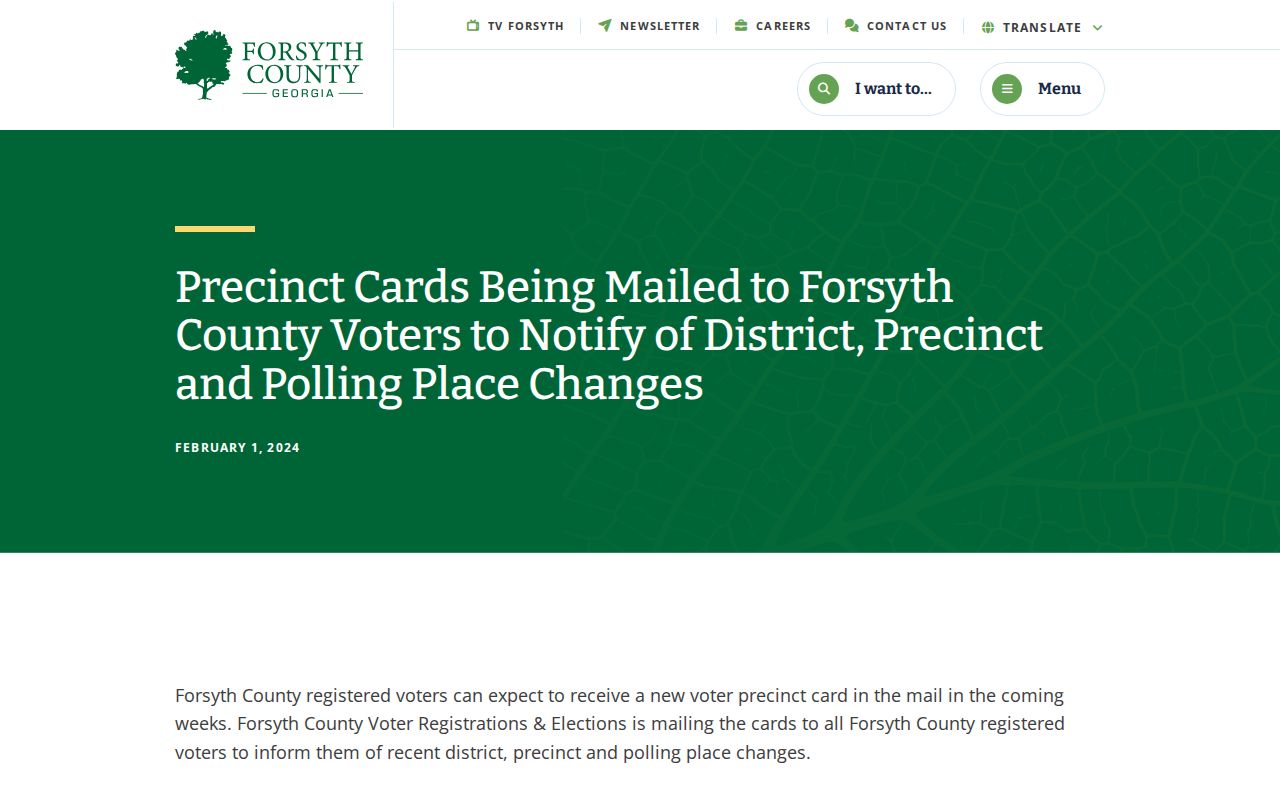
That notice is a useful reminder to compare a dated card or data export with MVP and the elections office before relying on an old precinct assignment.
Protected Forsyth Voter Addresses
Georgia has more than one protection path. VoteSafe covers qualifying voters affected by family violence or stalking, as well as people in qualifying shelters. A protected residence remains confidential, and certification lasts four years. Moving to another county requires a new application. The program's mailing address is not itself confidential, so applicants should follow official instructions carefully.
Safe at Home, created under O.C.G.A. § 50-18-150 et seq., provides eligible survivors with a substitute address, mail forwarding, and a sealed voter-roll address. It is not a general deletion service. A protected address should stay suppressed or substituted even when other voter fields are available. Contact the originating custodian to correct a disclosure concern rather than treating the Georgia Open Records Act as a way to erase an accurate public record.
Note: Never use voter records to threaten, harass, or locate a protected person; public access does not excuse unlawful conduct.
Order Forsyth Voter Registration Files
The Georgia Secretary of State voter-list order route supplies broader files under the limits of O.C.G.A. §§ 21-2-225 and 21-2-234. The order form requests the buyer's name, billing address, date, contact details, list type, geography, active-status choice, payment information, and signature. A Forsyth County list costs $70 under the fee schedule effective July 1, 2024. A county district costs $45, while a county precinct order covering up to five precincts costs $35.
- Choose the list type and whether it should contain active voters only or both active and inactive voters.
- Identify Forsyth County and any needed municipality, district, or precinct numbers, then complete the purchaser and payment fields.
- Sign and submit the order. Online purchases use a card; mailed orders use a check or money order sent to the Secretary of State.
- Allow the stated two-week standard processing period. Orders are not expedited, delivery is electronic, and fees are nonrefundable.
County and other local lists arrive as CSV files, a format that opens in spreadsheet or database software. The statewide file is delivered as text for import. Delivery is by email. A returned check carries a $40 fee.
The official order page explains the available products and rules.
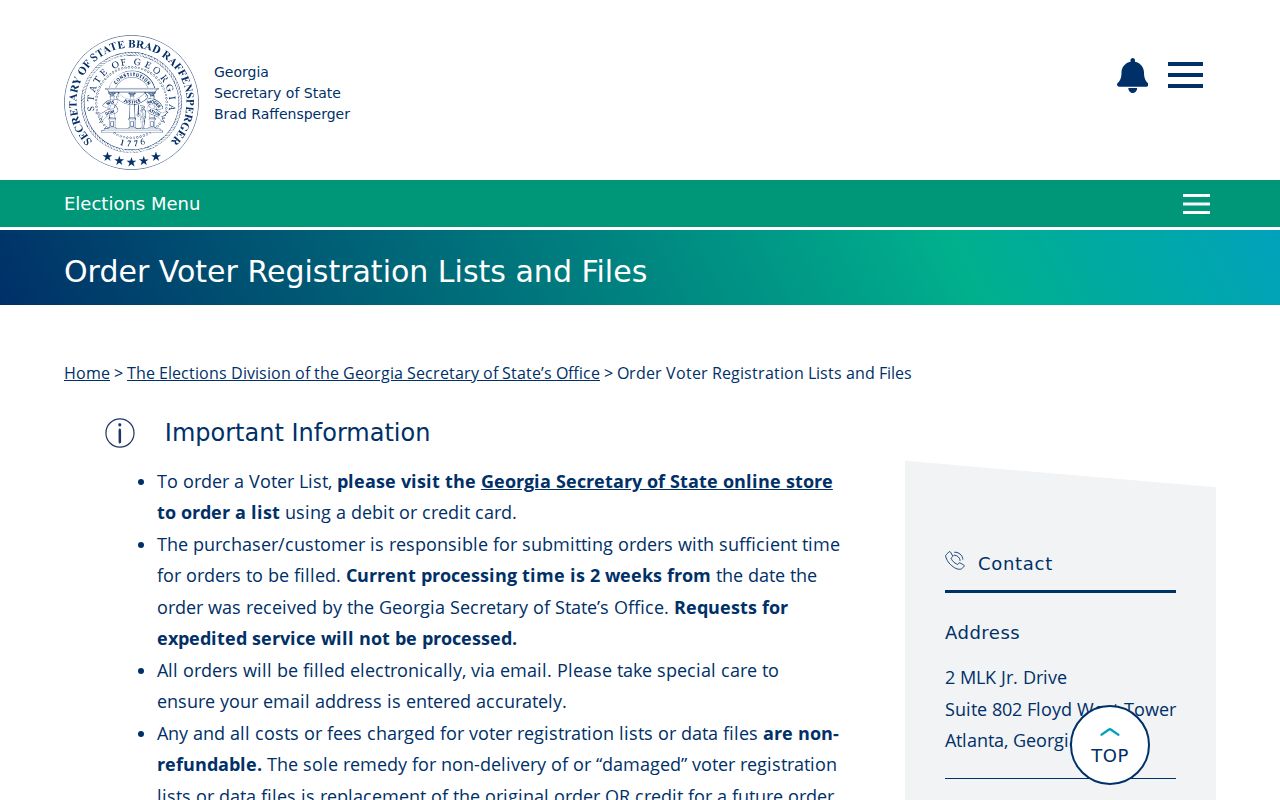
The captured order page helps distinguish the paid export from the free personal MVP lookup. O.C.G.A. § 21-2-601 makes commercial use of an elector list furnished under § 21-2-225 a misdemeanor. Harassment is also unlawful. The general process for other county material belongs with Forsyth County public records requests, but voter files follow these election-law rules.
Historical Forsyth Voter Registers
MVP answers current registration questions. It does not replace historical poll lists or registration registers. Older Forsyth County voter research should move to Georgia Archives, county-held records, and available microfilm collections. The exact historical register series and coverage years were not confirmed in the static sources, so requesters should ask by record type, election, and approximate year rather than assume a complete online run.
Forsyth County was created in 1832, which creates a clear boundary for early research. Records from before county formation may belong with predecessor jurisdictions or Cherokee-era and land-lottery sources. Modern voter rolls and old poll books also answer different questions. Current voter registration data tracks present election administration; a historic poll list may document who appeared for a particular election, within the limits of that surviving series.
Begin a historical request with the person's full name, spelling variants, the place where the person lived, and a narrow span of election years. Ask whether the repository holds a poll list, registration book, precinct return, or microfilm copy. Those terms describe different records, and one surviving series does not prove that another exists. A poll list can place a name at an election, but it should be checked against deeds, probate files, census schedules, newspapers, or other dated sources before drawing a broader conclusion about residence.
Current privacy rules still deserve care when old material is easy to copy. Use the minimum details needed for family history or civic research. Do not publish an address merely because it appears in a register. For a living person, confirm the context and avoid combining historical voter data with present contact details in a way that could cause harm.